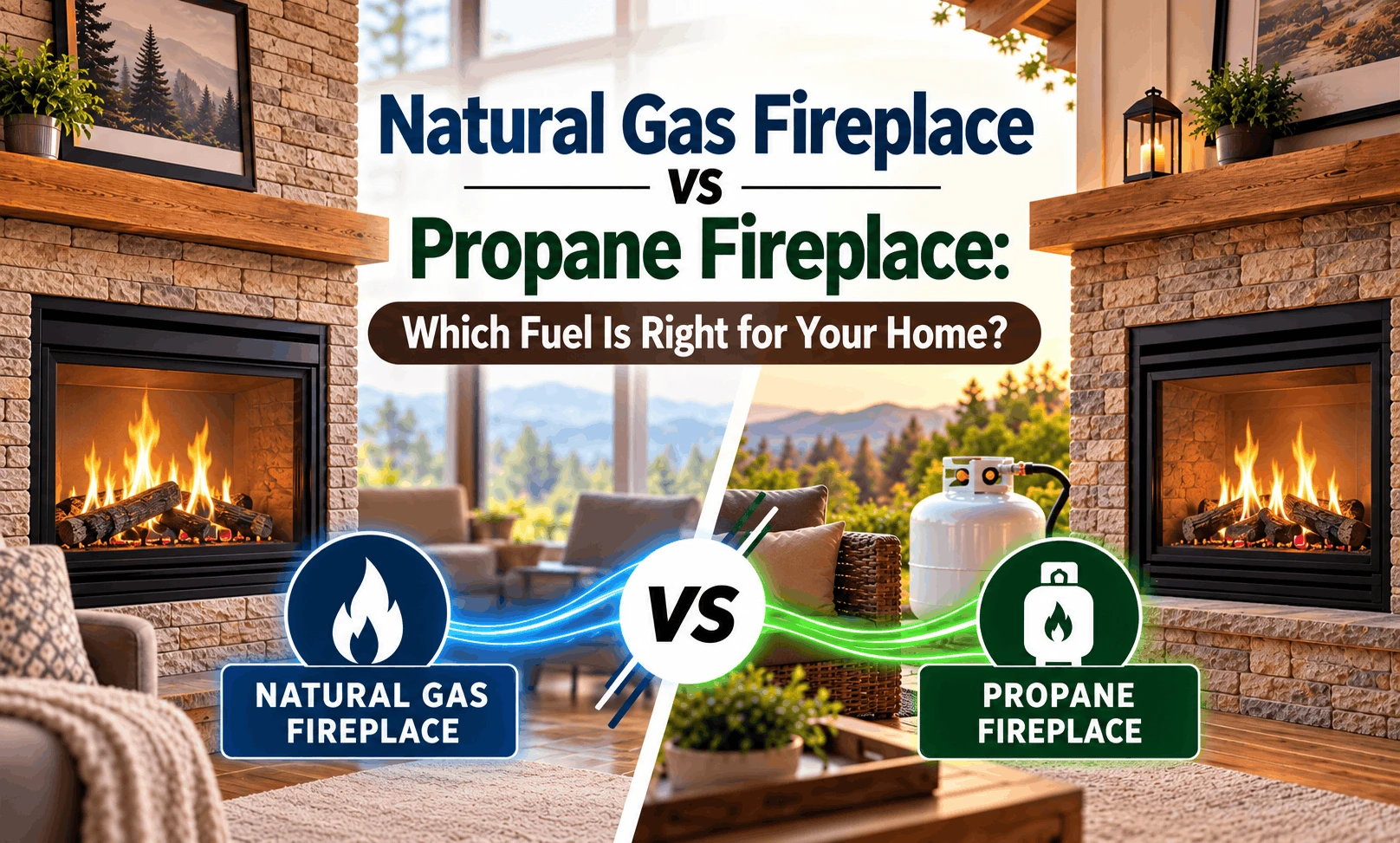











Natural Gas Fireplace vs Propane Fireplace: Which Fuel Is Right for Your Home?
Posted by Anna William on Oct 23rd 2026
When you're comparing a natural gas fireplace vs. a propane fireplace, the deciding factor is usually the fuel your home can already reach. A natural gas fireplace is generally the better choice if your home is connected to a utility gas line, since it costs less to run and never needs a refill. A propane fireplace is the better choice when natural gas isn't available, because it delivers the same realistic flames and steady heat from an on-site tank. That makes propane well suited to rural homes, mountain cabins, and properties outside city gas service.
? Quick Answer: Natural Gas vs. Propane Fireplace
- Choose natural gas if your home already has utility gas service. It usually costs less to run and never needs a refill.
- Choose propane if natural gas can't reach your property. It's ideal for rural homes, cabins, and detached spaces.
- Heat output: set by the fireplace's BTU rating, not the fuel
- Safety: both are very safe with professional installation, proper venting, CO detectors, and annual inspections
- Flexibility: many models convert between fuels with a manufacturer-approved kit
Both fuels heat well, burn cleanly, and give you the comfort of a fire at the push of a button. The real differences are in fuel cost, installation, supply convenience, and long-term upkeep. Below, we cover each of these so you can choose the fuel that fits your home, your budget, and the way you use your fireplace.
Table of Contents
- What's the Difference Between Natural Gas and Propane?
- Heat Output: Does One Fuel Burn Hotter?
- Cost of Propane vs Natural Gas: What You'll Actually Pay
- Installation and Placement Considerations
- Safety: What You Should Know About Each Fuel
- Pros and Cons at a Glance
- Which One Should You Choose?
- Can You Convert a Fireplace From One Fuel to the Other?
- Frequently Asked Questions
- Bottom Line
What's the Difference Between Natural Gas and Propane?
The two fuels differ in what they are and how they reach your home.
Natural gas is mostly methane. Your local utility delivers it through underground pipes, and a meter measures how much you use. If your home already has a gas furnace, water heater, or range, you probably have natural gas service.
Propane, the most common type of liquefied petroleum gas (LPG), is stored as a liquid under pressure in a tank on your property. A supplier refills the tank on a schedule or when you call. Inside the fireplace, it burns as a gas, just like natural gas.
Why it matters: The delivery method shapes almost everything else: installation, ongoing cost, how often you have to think about fuel, and where the fireplace can go.
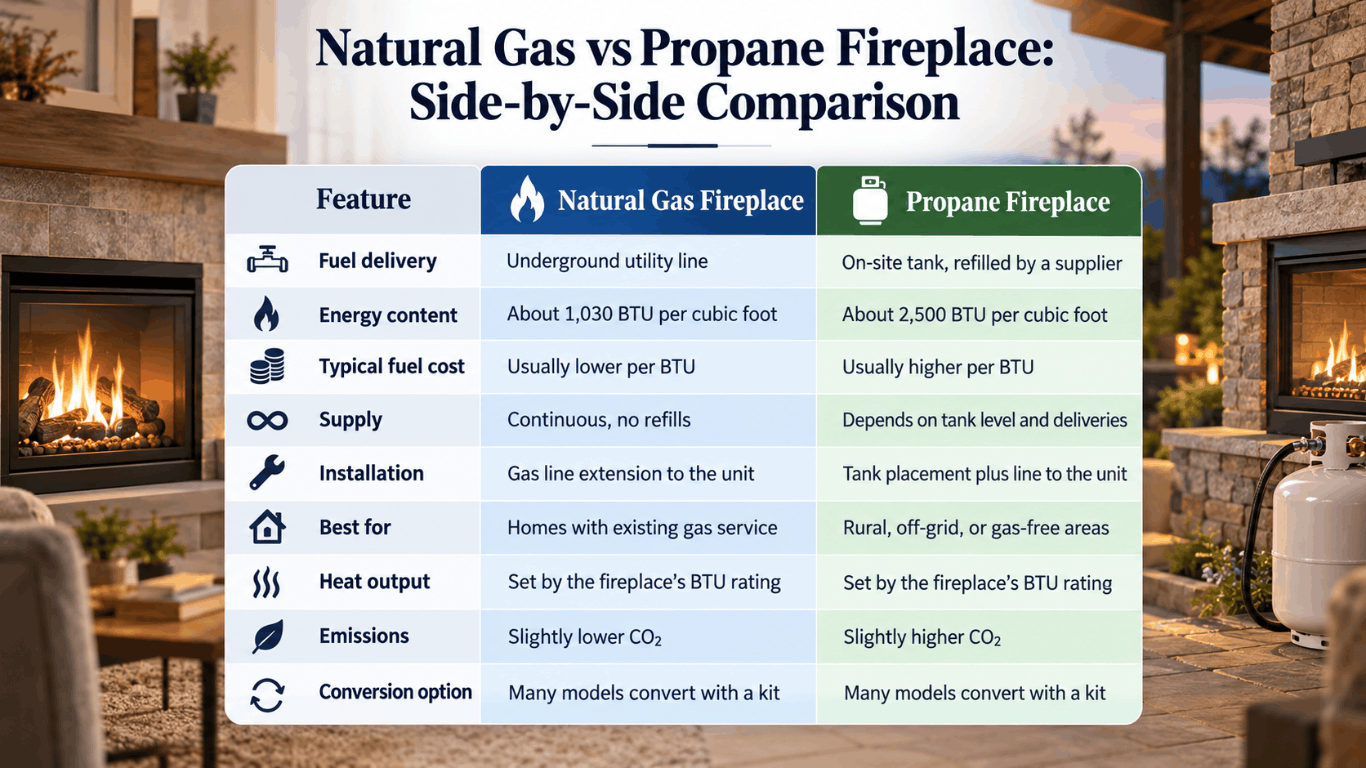
Natural Gas vs Propane Fireplace: Side-by-Side Comparison
| Feature | Natural Gas Fireplace | Propane Fireplace |
|---|---|---|
| Fuel delivery | Underground utility line | On-site tank, refilled by a supplier |
| Energy content | About 1,030 BTU per cubic foot | About 2,500 BTU per cubic foot |
| Typical fuel cost | Usually lower per BTU | Usually higher per BTU |
| Supply | Continuous, no refills | Depends on tank level and deliveries |
| Installation | Gas line extension to the unit | Tank placement plus line to the unit |
| Best for | Homes with existing gas service | Rural, off-grid, or gas-free areas |
| Heat output | Set by the fireplace's BTU rating | Set by the fireplace's BTU rating |
| Emissions | Slightly lower CO₂ | Slightly higher CO₂ |
| Conversion option | Many models convert with a kit | Many models convert with a kit |
Heat Output: Does One Fuel Burn Hotter?
People often hear that propane "burns hotter." Propane does hold more energy per cubic foot, roughly two and a half times as much as natural gas. Your fireplace accounts for that difference, though. Propane units use smaller burner orifices and different pressure settings, so they burn less volume to reach the same output.
What actually sets your heat is the BTU rating of the fireplace. A 35,000 BTU natural gas unit and a 35,000 BTU propane unit put out about the same warmth. Your comfort depends more on these factors:
- The size and BTU rating of the unit
- Venting type (direct vent or vent-free)
- Room size, ceiling height, and insulation
- Whether the fireplace has a blower to circulate heat
Tip: Choose your fuel based on access and cost, and size the fireplace to your room.
A note for higher elevations: If you live at altitude, as many of our Colorado customers do, gas appliances usually need to be derated or adjusted for thinner air. Derating is commonly around 4% for every 1,000 feet above 2,000 feet, but the exact requirement depends on the manufacturer. A qualified installer will set this up correctly, whichever fuel you choose.
Cost of Propane vs Natural Gas: What You'll Actually Pay
For most homeowners, cost is the biggest factor, and it splits into two parts: what you pay to run the fireplace and what you pay to install it.
1. Operating Costs
Where it's available, natural gas usually costs less per unit of heat than propane. Prices change with region, season, and supplier, so the most reliable approach is to compare cost per BTU using your own local rates:
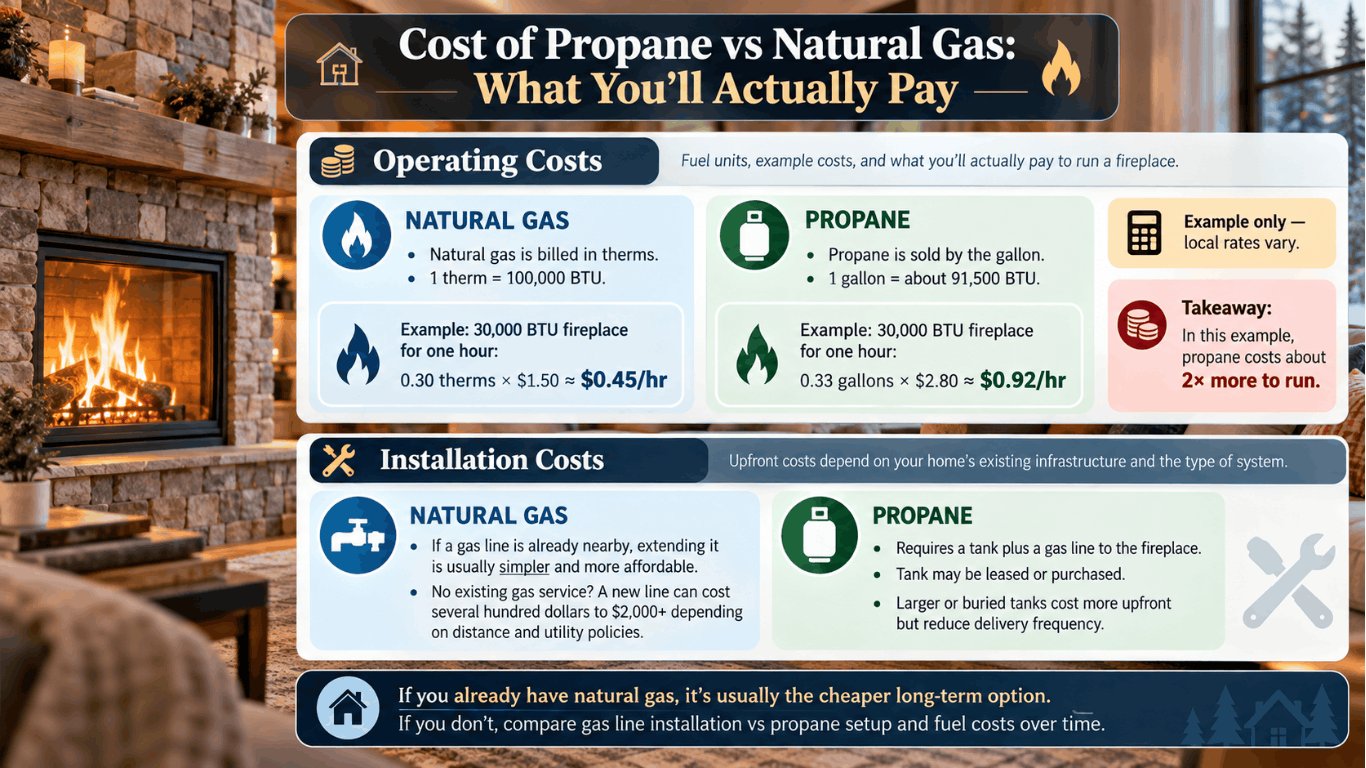
- Natural gas is billed in therms. One therm equals 100,000 BTU.
- Propane is sold by the gallon. One gallon holds about 91,500 BTU.
Here's an example using illustrative prices. Suppose natural gas costs $1.50 per therm and propane costs $2.80 per gallon. Running a 30,000 BTU fireplace for one hour would cost about:
| Fuel | Calculation | Estimated Cost per Hour |
|---|---|---|
| Natural Gas | 0.30 therms × $1.50 | ≈ $0.45 |
| Propane | 0.33 gallons × $2.80 | ≈ $0.92 |
Note: In this example, propane costs about twice as much to run. The gap in your area could be smaller or larger, and propane prices often rise in winter when demand peaks. To get your own numbers, plug your utility rate and your propane supplier's quote into the same math.
Your habits matter too. A high-efficiency direct-vent fireplace, sized properly and used to heat the rooms you actually spend time in, can cut your fuel use more than switching fuels would.
2. Installation Costs
Installation can change the overall picture:
| Fuel | What Installation Involves |
|---|---|
| Natural Gas | If a gas line already runs near the fireplace location, extending it is usually simple and affordable. If your home has no gas service, getting a new line from the street can cost from several hundred dollars to $2,000 or more, depending on the distance and your utility's policies. In some areas, utility service isn't offered at all. |
| Propane | You'll need a tank plus a line to the fireplace. Some homeowners lease a tank from their supplier, while others buy one outright. Larger tanks and buried tanks cost more to install but mean fewer deliveries. |
Our recommendation: If you already have natural gas, it's almost always the cheaper option over time. If you don't, compare the cost of bringing in a gas line against propane setup plus years of propane fuel costs.
Installation and Placement Considerations
Both fuels need professional installation, and neither should be a DIY job. Here's how they compare in practice.
Natural gas fireplaces are tied to the utility line, so the best location is usually near existing gas piping. Longer runs are possible but add labor and material costs.
Propane fireplaces give you more flexibility in some ways. You can install one in a detached studio, a cabin, a three-season room, or an outdoor living space with no utility service nearby. The tank has to meet local code for distance from buildings, property lines, and ignition sources, so placement needs planning.
Don't overlook venting: For either fuel, venting is just as important as the fuel line. Direct-vent fireplaces draw combustion air from outside and send exhaust back outside through a sealed system. That makes them one of the safest and most efficient options for your living space.
If you're still deciding on a fireplace style, our guide to the types of gas fireplaces explains how each one works.
Safety: What You Should Know About Each Fuel
Natural gas and propane fireplaces are both very safe when they're installed and maintained correctly. Modern units include sealed fireboxes, flame sensors, and automatic shutoff valves. A few differences are worth knowing:
- Natural gas is lighter than air. If a leak happens, it tends to rise and disperse.
- Propane is heavier than air. A leak can collect in low areas such as basements. This is a big reason professional installation and regular inspections matter.
- Both fuels contain an added odorant that smells like rotten eggs so you can notice a leak.
Safety note: If you ever smell the rotten-egg odor, leave the house right away and call your gas utility or propane supplier from outside.
To keep your home safe with either fuel:
- Hire a licensed gas professional for installation, gas line work, and any fuel conversion.
- Never connect a natural gas fireplace to propane, or the reverse, without the manufacturer-approved conversion kit installed by a qualified technician. Using the wrong fuel can produce dangerous flames, soot, or carbon monoxide.
- Install carbon monoxide detectors on every level of your home, especially near sleeping areas.
- Schedule an annual inspection to check burners, valves, venting, and seals.
If you'd like to know what yearly upkeep involves, our article on whether gas fireplaces need to be cleaned explains what to expect. If you're curious about unvented models, we also answer whether ventless gas fireplaces are safe.
Environmental Impact
Both fuels burn far cleaner than wood, with much less smoke, ash, and fine particulate pollution. That's a big part of why so many homeowners switch from wood-burning to gas.
Between the two, natural gas releases about 15% less carbon dioxide per unit of heat. Propane has its own advantage: if it leaks before burning, its direct warming effect is far smaller than methane's. In everyday home use, the environmental difference between them is small.
Tip: Choosing an efficient, correctly sized fireplace will do more for your footprint than the choice of fuel.
Pros and Cons at a Glance
| Fuel | Pros | Cons |
|---|---|---|
| Natural Gas Fireplace |
|
|
| Propane Fireplace |
|
|
Natural Gas vs Propane Fireplace: Which One Should You Choose?
In most cases, your situation points to the answer:
| Your Situation | Best Choice |
|---|---|
| You already have natural gas service | Choose natural gas. It costs less to run, and you'll never schedule a delivery. |
| You have no gas service, and the utility can't reach you | Choose propane. It's a dependable, efficient way to enjoy a gas fireplace. |
| Gas service is available at the street but not connected | Get a quote for the line installation and compare it with propane setup and long-term fuel costs. |
| You're heating a cabin, vacation home, or detached space | Propane is usually the more practical option. |
| You already use propane for other appliances | A propane fireplace can share your existing tank, which can make it easier to justify. |

Can You Convert a Fireplace From One Fuel to the Other?
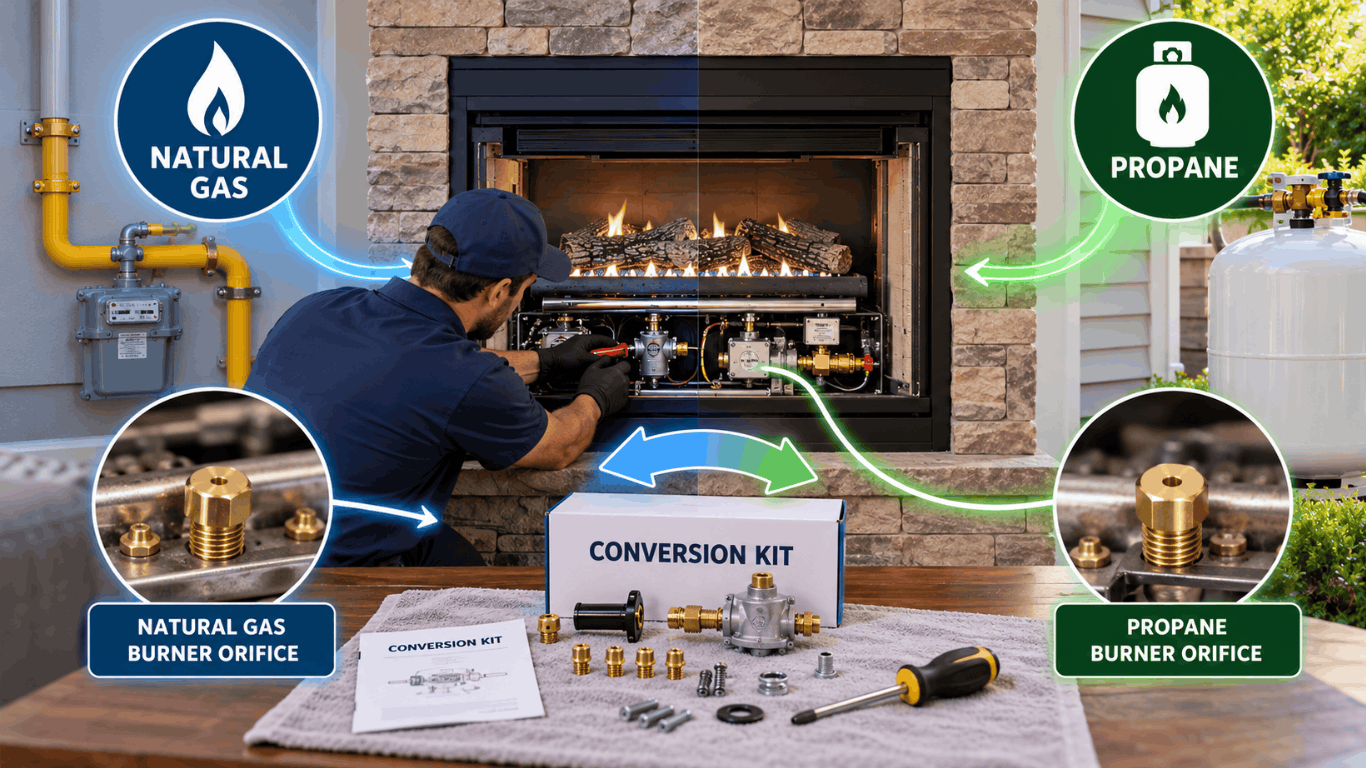
Many gas fireplaces are factory-set for one fuel but can be converted to the other with a manufacturer-approved kit. Some models include the kit in the box, others sell it separately, and a few can't be converted at all. Convertibility helps if you think you might switch fuels later, for example, if natural gas service comes to your street.
Safety note: Conversion is never something to improvise. It involves changing burner orifices, pressure regulators, and valve settings to the manufacturer's exact specifications. Always use the approved kit for your model and have a licensed technician do the work.
Tip: If you might switch fuels in the future, ask about convertible models before you buy.
Frequently Asked Questions
Is propane or natural gas cheaper for a fireplace?
Natural gas is usually cheaper per BTU where it's available. Prices vary by region, so compare your local rates using cost per BTU.
Will a propane fireplace heat my room better than a natural gas fireplace?
No. Heat output depends on the BTU rating. Two fireplaces with the same rating produce about the same heat, regardless of fuel.
Can I use a propane tank with a natural gas fireplace?
Only after a licensed technician installs the manufacturer-approved conversion kit. Connecting the wrong fuel without converting the unit is unsafe.
Do gas fireplaces need electricity?
Many models use a millivolt or battery-backup ignition, so the flame can still run during a power outage. Blowers, accent lighting, and some remote features won't work without power, so you'll get radiant heat only. Check the specifications of the model you're considering.
Bottom Line
Comparing a natural gas fireplace vs propane fireplace isn't about which fuel is better overall. It's about which one suits your home. If you already have natural gas, you'll get lower running costs and an uninterrupted supply. If gas lines don't reach your property, propane gives you the same warmth and ambiance with more freedom in where you install it. With either fuel, professional installation, proper venting, a working CO detector, and an annual inspection keep your fireplace safe and efficient for years.
At Embers Living, we help homeowners find gas fireplaces that fit their space, their fuel source, and their style. You can browse our full selection of gas fireplaces, along with log sets, electric models, and outdoor living essentials, at blazingembers.com.
Not sure whether natural gas or propane makes more sense for your home? Talk to our team. We'll walk you through BTU sizing, venting options, and convertible models so you can buy with confidence. Email us at sales@embersliving.com, call 303-800-5659, stop by the showroom to see the flames in person, or contact us online. Our Embers Living team will help you choose the right fireplace.