








How to Use a Pellet Grill: A Simple Step-by-Step Guide
Posted by Anna William on Sep 24th 2026
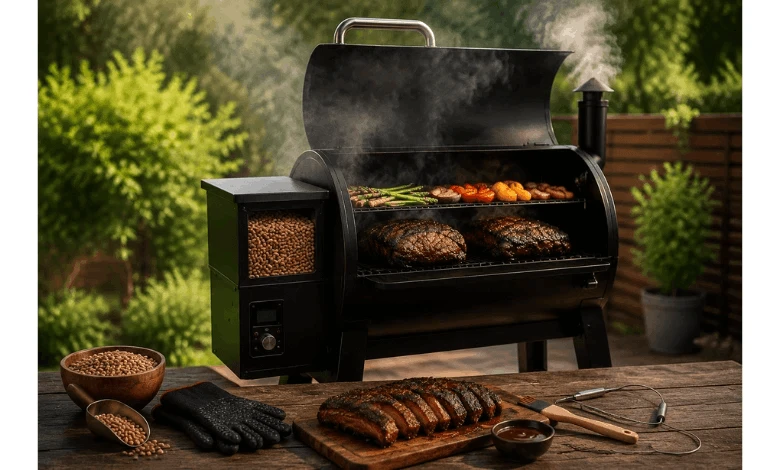
If you’ve just wheeled a brand-new grill onto the patio and you’re staring at a hopper full of wood pellets, wondering where to begin, learning how to use a pellet grill is far simpler than the control panel makes it look. The process is simple: fill the hopper with hardwood pellets, run the ignition cycle, set your target temperature, preheat until the smoke turns thin and blue, cook to internal temperature with a probe thermometer, and finish with the shutdown cycle.
That’s the whole loop, and it becomes muscle memory after two cooks. We fire these grills every week on our showroom floor, so here’s the process, plus the temperature chart and the fixes most manuals leave out.
Note: Pellet grills vary by model. Always check your owner’s manual before your first ignition, before seasoning the grill, and before changing controller settings.
Table of Contents
- What Is a Pellet Grill, and How Does It Work?
- What You Need to Use a Pellet Grill
- How to Use a Pellet Grill: The 8-Step Cook
- Pellet Grill Temperature Guide
- Choosing the Right Wood Pellets
- Pellet Grill Maintenance and Safety
- Pellet Grill Troubleshooting
- How Often Should You Clean a Pellet Grill?
- Frequently Asked Questions
- Ready to Fire Up Your Own?
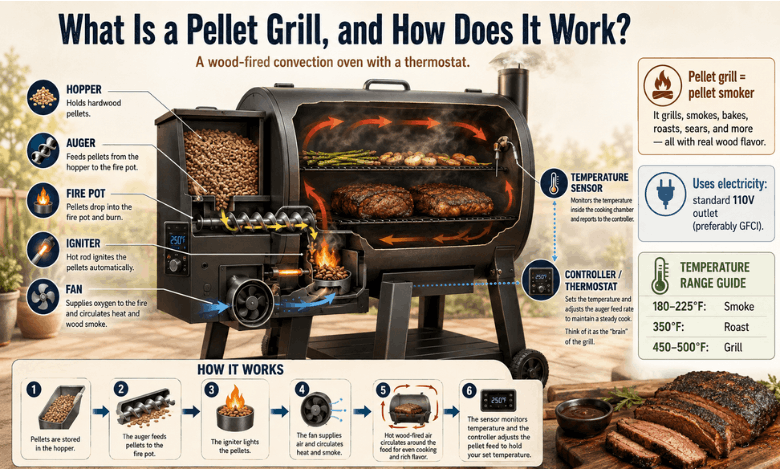
What Is a Pellet Grill, and How Does It Work?
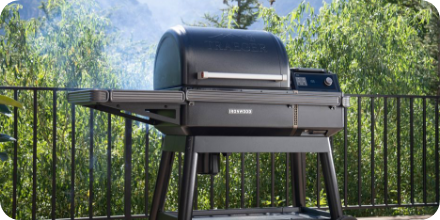
A pellet grill is an electric-powered outdoor cooker that feeds compressed hardwood pellets from a hopper into a fire pot, where an igniter lights them and a fan circulates heat and wood smoke around the chamber. In short, it is a wood-fired convection oven with a thermostat.
So, how does a pellet grill work? You set a temperature, the auger drops pellets in, the igniter lights them, and a sensor reports back so the controller can adjust the feed rate. That feedback loop is why pellet grills hold a setpoint better than any grill you tend by hand.
A pellet grill and a pellet smoker are the same machine, so if you have been searching for how to use a pellet smoker, everything here applies. At 180–225°F it smokes, at 350°F it roasts, at 450–500°F it grills. Do pellet grills need electricity? Yes, a standard 120V household outlet, ideally GFCI-protected.
What You Need to Use a Pellet Grill
You do not need much for your first cook. Keep these basics on hand:
- 100% hardwood, food-grade pellets: Never heating pellets.
- A GFCI-protected 120V outdoor outlet: Within reach of the grill’s cord.
- A probe thermometer: A leave-in probe for large cuts, an instant-read for spot checks.
- Drip-tray liners: Catch grease and cut cleanup time.
- A shop vacuum: For clearing ash out of the fire pot.
- A grill brush or scraper: For burning off and clearing the grates.
- An airtight pellet container: Damp pellets crumble and jam the auger.
- A smoke tube (optional): For heavier smoke flavor at higher temperatures.
How to Use a Pellet Grill: The 8-Step Cook
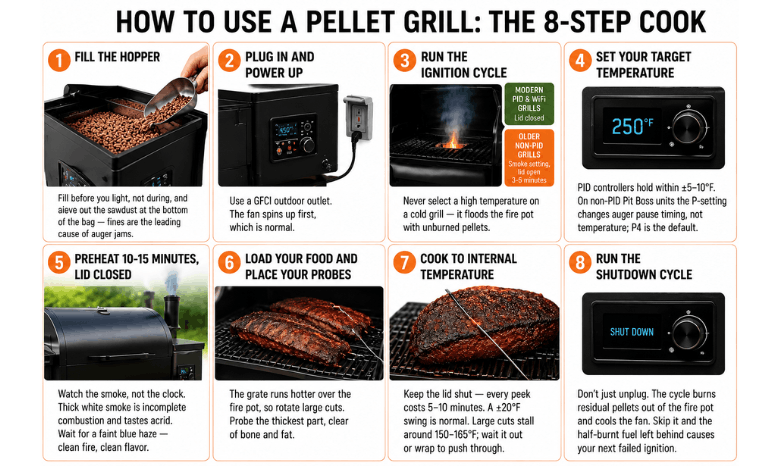
1. Fill the Hopper
Fill before you light, not during, and sieve out the sawdust at the bottom of the bag.
Sawdust fines and damp pellets are the two common causes of auger jams.
2. Plug In and Power Up
Use a GFCI outdoor outlet. The fan spins up first, which is normal.
3. Run the Ignition Cycle
Do you leave the lid open when starting a pellet grill? It depends on your model, not your brand, so check the manual.
Almost every grill built in the last decade ignites with the lid closed. Older units, such as pre-2016 Traegers, start on Smoke with the lid open for 3 to 5 minutes until the fire establishes.
Never select a high temperature on a cold grill. It floods the fire pot with unburned pellets, which either smothers the igniter or lights all at once.
4. Set Your Target Temperature
PID controllers hold within ±5–10°F.
On non-PID Pit Boss units, the P-setting changes how long the auger pauses between feeds, not the temperature. P4 is the default, and it only works in Smoke mode — it does nothing once you select a set temperature. Pushing it too high can starve the fire and cause a flameout.
5. Preheat for 10 to 15 Minutes, Lid Closed
Allow up to 30 minutes on a large insulated model like a Timberline.
Watch the smoke, not the clock. Wait for a faint blue haze — clean fire, clean flavor.
6. Load Your Food and Place Your Probes
The grate runs hotter over the fire pot, so rotate large cuts.
Probe the thickest part, clear of bone and fat.
7. Cook to Internal Temperature
Keep the lid shut. As a rule of thumb, every peek costs you several minutes of recovery.
Expect a ±10–20°F swing on older controllers; PID units hold far tighter. Large cuts stall around 150–165°F; wait it out or wrap to push through.
8. Run the Shutdown Cycle
Do not just unplug. The cycle burns residual pellets out of the fire pot and cools the fan.
Skip it, and the half-burnt fuel left behind causes your next failed ignition.
Pellet Grill Temperature Guide
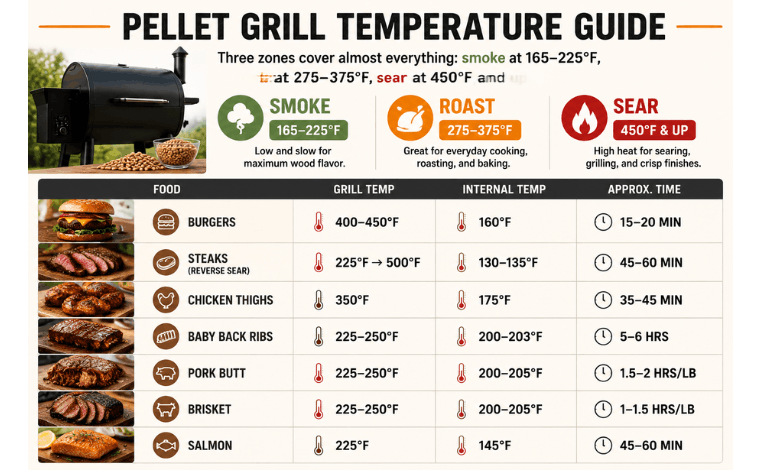
Three zones cover almost everything: smoke at 165–225°F, roast at 275–375°F, sear at 450°F and up.
| Food | Grill Temp | Internal Temp | Approx. Time |
|---|---|---|---|
| Burgers | 400–450°F | 160°F | 15–20 min |
| Steaks (reverse sear) | 225°F → 500°F | 130–135°F | 45–60 min |
| Chicken thighs | 350°F | 175°F | 35–45 min |
| Baby back ribs | 225–250°F | 200–203°F | 5–6 hrs |
| Pork butt | 225–250°F | 200–205°F | 1.5–2 hrs/lb |
| Brisket | 225–250°F | 200–205°F | 1–1.5 hrs/lb |
| Salmon | 225°F | 145°F | 45–60 min |
Food safety note: The USDA recommends 145°F with a 3-minute rest for whole cuts of beef and pork, 160°F for ground meat, and 165°F for all poultry. The higher figures above are for texture, not safety, and 130–135°F is the common medium-rare target, which is below the USDA minimum.
Cook to internal temperature — thickness and weather move these numbers. For more smoke, run the first hour low and add a smoke tube. To sear, use cast-iron grates or reverse-sear: smoke low, then finish hot for 90 seconds a side.
Choosing the Right Wood Pellets
Buy 100% hardwood, food-grade pellets, never heating pellets. The best wood pellets for smoking depend on the cut:
- Mild: Apple, cherry, and alder, for pork, poultry, and fish.
- Medium: Oak and pecan, reliable all-rounders for almost anything.
- Strong: Hickory and mesquite, for beef and ribs.
Store them airtight, since damp pellets crumble and jam the auger.
Pellet Grill Maintenance and Safety
Before your first cook, prime the auger and season the grill empty at 350–450°F for 30 to 45 minutes to burn off manufacturing oils. Check your manual, as brands differ.
After that, using a pellet grill well means burning off the grates after each cook, changing the drip-tray liner every 2 to 3 cooks, and vacuuming ash from the fire pot every 3 to 5 cooks.
On placement, keep the grill well away from the house, deck railings, eaves, and overhanging branches. The NFPA sets no single distance, and many local codes require 10 feet for apartments and condos. Keep children and pets three feet back, and empty the grease bucket regularly, since the drip tray is the real fire risk.
Never run a pellet grill in a garage or enclosed porch. Burning wood produces carbon monoxide.
Pellet Grill Troubleshooting
| Problem | Cause | Fix |
|---|---|---|
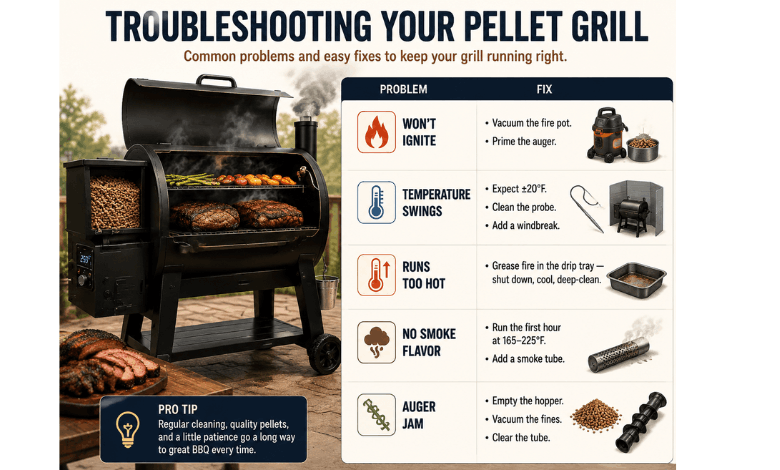
| Will not ignite | Ash buildup or an empty auger tube | Vacuum the fire pot and prime the auger |
| Temperature swings | A dirty probe or wind across the chamber | Expect ±20°F; clean the probe and add a windbreak |
| Runs too hot | A grease fire in the drip tray | Shut down, let it cool, then deep-clean |
| No smoke flavor | Running too hot for the whole cook | Run the first hour at 165–225°F and add a smoke tube |
| Auger jam | Sawdust fines or damp pellets | Empty the hopper, vacuum the fines, clear the tube |
How Often Should You Clean a Pellet Grill?
| Timing | Maintenance Task |
|---|---|
| After every cook | Burn off the grates |
| Every 2 to 3 cooks | Change the drip-tray liner |
| Every 3 to 5 cooks | Vacuum ash from the fire pot |
| Before every long cook | Empty the grease bucket |
Frequently Asked Questions
Do pellet grills need electricity?
Yes. A pellet grill runs its auger, igniter, fan, and controller on a standard 120V household outlet, ideally GFCI-protected.
Do you leave the lid open when starting a pellet grill?
It depends on your model, not your brand, so check the manual. Almost every grill built in the last decade ignites with the lid closed. Older units, such as pre-2016 Traegers, start on Smoke with the lid open for 3 to 5 minutes until the fire establishes.
How long does a pellet grill take to preheat?
Usually 10 to 15 minutes with the lid closed, and up to 30 minutes on a large insulated model. Watch the smoke rather than the clock and wait for a faint blue haze.
What is the P-setting on a pellet grill?
On non-PID Pit Boss units, the P-setting changes how long the auger pauses between feeds, not the temperature. P4 is the default, it only works in Smoke mode, and pushing it too high can starve the fire and cause a flameout.
What are the best wood pellets for smoking?
It depends on the cut. Apple, cherry, and alder are mild and suit pork, poultry, and fish. Oak and pecan are medium all-rounders. Hickory and mesquite are strong and pair well with beef and ribs. Always use 100% hardwood, food-grade pellets, never heating pellets.
Can you sear on a pellet grill?
Yes. Use cast-iron grates, or reverse-sear by smoking low and then finishing hot for about 90 seconds a side.
Why does my pellet grill have no smoke flavor?
Smoke output drops as the temperature rises. Run the first hour at 165 to 225°F and add a smoke tube if you want more.
Do you have to season a new pellet grill?
Yes. Prime the auger and run the grill empty at 350 to 450°F for 30 to 45 minutes to burn off manufacturing oils. Check your manual first, as brands differ.
Can you use a pellet grill in a garage or covered porch?
No. Burning wood produces carbon monoxide, so a pellet grill should never be run in a garage or an enclosed porch. Keep it well away from the house, deck railings, eaves, and overhanging branches.
Ready to Fire Up Your Own?
Knowing how to use a pellet grill comes down to good pellets, a clean fire pot, a preheat to thin blue smoke, a probe in the meat, and a full shutdown at the end. Get those five right and the controller handles the rest.
At Embers Living, we help you find the right pellet grill and accessories to build a better outdoor cooking experience, with quality options designed for beginners and experienced grillers alike. Browse our freestanding pellet grills and built-in pellet grills when you’re ready to upgrade — we keep them on the floor from Traeger, Yoder, Memphis, and more.
Still choosing between models? Visit our blog section, email us at sales@embersliving.com, or call 303-800-5659. Our Embers Living support team is here to help you light up your home.